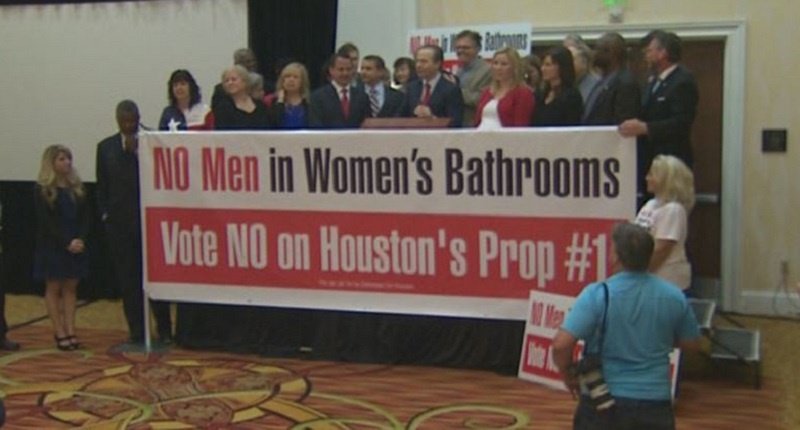
HOUSTON – The voters of Houston didn’t fall for the deception.
But what about people in other states and municipalities, who are duped into accepting laws that quietly allow transgender people to use the public restrooms or showers of their choice, regardless of their biological gender?
MORE NEWS: From Classroom to Consulate Chef: Culinary Student Lands Dream Job at U.S. Embassy in Paris
As originally written, the Houston Equal Rights Ordinance (HERO) specifically allowed that. But the straightforward words caused a big fuss, so the proponents of the ordinance removed it.
By the time the ordinance was up for a public vote on Tuesday, those proponents were claiming that all the warnings about transgender restroom access were “false and misleading.”
“So the ads focused exclusively on the bathroom issue even though the law had nothing to do with that,” said Seth Meyers, host of NBC’s Late Night with Seth Meyers.
But some honest journalists knew better and gave voters a fair warning, so they could make an informed decision.
“The gender identity provision is still in there, and theoretically still has the same effect,” Houston Public Media reporter Florian Martin told the Texas Standard. “You can’t block someone from going into a bathroom that conforms with their gender identity.”
In the end voters saw through the ruse and soundly rejected the ordinance, after fighting all the way to the Texas Supreme Court for the right to vote on it.
But the issue is far from settled in many other states and communities across the nation.
MORE NEWS: Know These Before Moving From Cyprus To The UK
According to the American Civil Liberties Union, 17 states and more than 225 U.S. cities have measures banning discrimination in housing, employment, and public accommodations based on sexual orientation and gender identify.
How many of them have hidden language that could be interpreted as free passes for transgender people to use public restrooms and showers of their choice?
Meanwhile, in states like Ohio, seemingly innocent efforts to protect people from various forms of discrimination could also incorporate transgender restroom/shower rights.
Keeping the choice away from the public
Why the need for language buried inside more expansive laws?
Because every time advocates raise the idea of allowing males into female facilities, or the other way around, the public usually objects in a stunned and angry manner.
“They know how ridiculous of a policy this really is, and that people are not going to stand for being exposed to the opposite gender,” said Karen England, executive director of the California-based Capitol Resource Family Alliance. “So they do it under guise of ‘public accommodations.’ This is how they get it in.”
Indeed, the key terms identifying disingenuous legislation tend to be “transgender,” “public accommodations,” “public property” or “public facilities.”
When you see or hear them in articles or discussions about discrimination, you know transgender access to public restrooms or showers, including school facilities, is probably part of the issue.
Amanda Terkel of the Huffington Post, in an article about the proposed Houston ordinance, wrote, “Prop. 1 never specifically mentioned bathrooms. It did, however, encompass barring discrimination in public accommodations, which includes public restrooms.”
That type of wording also popped up last summer in Nevada, in a law quickly pushed through the legislature by Gov. Brian Sandoval and his supporters.
The governor pressured lawmakers to pass the bill before the end of their bi-annual session, claiming it was simply a much needed “anti-bullying” law for schools. The legislators obliged and the bill quickly became law.
But attorneys for the Arizona-based Alliance Defending Freedom quickly analyzed the legislation and found the smoking gun.
‘“SB 504 confers a new right on students who do not conform with their gender,” the group’s legal opinion said. “Specifically, it protects persons from being bullied because of their ‘gender identity;’ that is, the gender with which one identifies, regardless of whether it is one’s biological sex.
“Bullying includes students, teachers and school administrators ‘blocking access’ to ‘any property or facility of a school.’ ‘Property or facility of a school’ includes restrooms and locker rooms, both of which must ‘be maintained in a safe and respectful manner’ for all students.
“Thus, SB 504 will require schools to allow males who claim to identify as female to access the restrooms, locker rooms, and perhaps shower rooms, designated for females. And it will allow females who identify as male to access the facilities designated for males.
“Any school official or student who tries to prevent this from occurring, or expresses discomfort that it is occurring, will be guilty of bullying.”
Several Nevada lawmakers who voted for the bill expressed shock when they later understood the transgender restroom/shower implications.
“I did not think that was part of the bill,” Nevada Assembly Speaker John Hambrick told EAGnews. “I have not seen the report that you saw. I really want to do my own research on this.”
“Had I known the provisions for (the bill), I would never have voted for it,” state Rep. Jim Wheeler was quoted as saying.
When contacted by EAGnews and asked to address the findings of Alliance Defending Freedom, Sandoval spokeswoman Mari St. Martin said she would research the issue and respond. But then she stopped communicating altogether.
The people need to act
Newly proposed legislation in Ohio is suspiciously similar to the Nevada legislation and Houston ordinance.
The bill is designed to look like an innocent attempt to prevent basic discrimination against gay or transgender people.
A good example comes from a story published by Spectrum.SunTimes.com, which says, “Ohio lawmakers are once again pushing for legislation to ban housing and workplace discrimination against LGBTQ people.”
When explained to the public in that manner, it obviously has widespread appeal. According to the same story, “Equality Ohio surveys show 79 percent of Ohio residents support such a law and believe Ohio already has one.”
But it doesn’t take long to recognize the suspicious language involved.
“The Ohio Fairness Act would prohibit discrimination on the basis of sexual orientation and gender identity in employment, housing and public accommodation, according to the Human Rights Campaign blog.”
Gender identity. Public accommodation. Put two and two together.
“They are very sneaky about it,” England said. “They are deceptive They know the only way to get it done is to deceive the public.
“It’s a matter of education, getting the word out, empowering the public.”
The answer to the problem lies with concerned citizens taking action, like they did in Houston, according to England.
That’s because elected politicians can’t always be trusted to respect the will of the people, she said.
In Houston, for instance, the city commission had already adopted the HERO ordinance in 2014, despite widespread public opposition.. Several citizens had to sue the city, and take the case all the way to the Texas Supreme Court, before the people were given the chance to vote it up for down.
Progressive elites like Houston Mayor Annise Parker want to impose what they believe is morally correct, regardless of how the public responded.
“It almost did not happen,” England said. “The voters were almost denied the right to vote on Proposition 1.
“With a deceptive name, the elites of Houston tried to push through the Houston Equal Rights Ordinance without a vote of the citizens. But Houston residents had a different plan and went to court to place the matter on the ballot.”
In 2013, the state of California passed AB 1266, guaranteeing open restroom choice for transgender students in public schools. Approximately 620,000 citizens signed a petition to overturn the law, but one in five of those signatures were rejected by state officials and the measure never reached the ballot.
Supporters claimed that of the signatures were rejected illegally, resulting in an ongoing lawsuit.
In the meantime, a group called Privacy for All is trying again in California. Members are gathering signatures to put the Personal Privacy Protection Act on the ballot. The law, if approved by voters, would require people on public property to use restrooms and showers that conform with their biological gender.
England, who works with Privacy for All, is confident that the group will gather the 366,000 valid signatures needed to put the Privacy Protection Act on the ballot, and believes the public will eventually approve it.
“Houston elites were afraid to let the voters vote, and they had good reason to be,” England said. “We think California elites have similar reason to be afraid.”


Join the Discussion
Comments are currently closed.