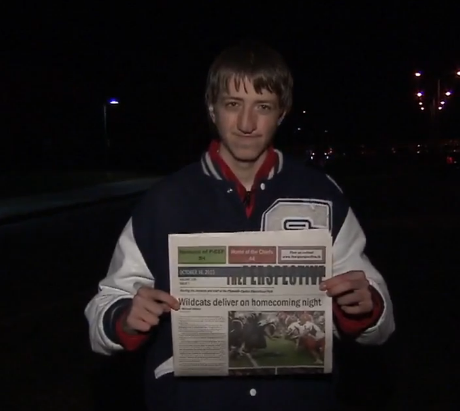
PLYMOUTH, Mich. – Salem High School student journalist Chris Robbins just got a lesson in government he likely won’t forget any time soon.
Officials with the Plymouth-Canton school district recently blocked students and staff from accessing numerous websites, and Robbins submitted a public information request to understand why some like Pinterest were banned while others were permitted, The Detroit News reports.
MORE NEWS: From Classroom to Consulate Chef: Culinary Student Lands Dream Job at U.S. Embassy in Paris
What he received from district officials was a bill for nearly $8,000 to retrieve the information.
“I’m not rich,” Robbins said. “I don’t have a job. I do choir and write for the student newspaper.”
“We thought it was a typo,” said Leola Gee, Robbins’ journalism teacher.
Robbins requested several pieces of information, including a copy of guidelines the district uses to determine which sites are blocked, a list of sites that were blocked and then unblocked through the appeals process, those that were appealed but not unblocked, emails from school staff who requested certain sites to be unblocked, and emails among officials tasked with determining which sites are appropriate.
 District officials responded with an itemized cost projection claiming it would take an employee who makes $44.93 per hour about 176 hours to gather the information, for a total cost of $7,917.15.
Robbins consulted with several experts about the request, and opted to appeal the decision. When he did, the district responded with an even bigger cost estimate of $8,806 – 176.3 hours at $49.95 an hour – “a totally ridiculous amount,” he told Fox 2 Detroit.
“Wow,” Robbins said. “Complete shock for them to charge a student for that much money.”
MORE NEWS: Know These Before Moving From Cyprus To The UK
Michael Reitz, attorney for the Mackinac Center for Public Policy, didn’t seem as surprised.
“The cost of fulfilling FOIA requests is the number one complaint we hear from people seeking public records,” Reitz said. “When government agencies send a big bill for FOIA requests, that effectively turns into a denial of the request.”
Reitz pointed out that changes to state law in January require government agencies to limit copying costs to 10 cents per page. The law also stipulates the lowest paid employee capable of completing the task must be used.
In Plymouth-Canton’s second response to Robbins it noted in its calculations the $49.95 hourly rate is “based on lowest salary of person responsible for compiling information.”
EAGnews.org is quite familiar with efforts by school districts to impose incredible fees in an effort to shield information from the public, particularly when the information exposes questionable spending or controversial issues.
As part of a series on runaway school spending, EAG submitted open records requests to 350 school districts in 50 states, asking primarily for travel records and personnel costs, and the responses were eye opening.
Most districts responded with the information free of charge, or for a modest fee to cover labor, copying and postage. But some districts responded with astronomical financial demands that made it impossible to obtain.
The Lincoln, Nebreaska district, for instance, wrote the “the estimate of the expected cost of fulfilling the request is $32,127.50.”
Baltimore City Public Schools provided a range of $8,010 to $32,130 for its travel records. For Omaha schools, it was $6,985, West Virginia’s Mercer County Public Schools wanted $10,000, and the St. Lucie Public schools in Florida demanded $11,543 for a breakdown of employees payments for unused sick days.
In Michigan’s Goodrich Area Schools district, parent Sherry Smith wanted to know what administrators were saying about her son, so she submitted a request for any school emails containing her son’s name or initials this fall.
School officials responded with a bill for $77,718, and estimated it would take 4,687.5 hours – or 2.2 years based on a typical 260-day work year – to provide the documents, MLive.com reports.
At Plymouth-Canton Community Schools, district officials claim to be simply following the law by imposing the massive costs for Robbins’ request.
“The FOIA process is often not well-understood by those who have not previously used it, and it is understandable that pupils may not be aware that Section 4 of the (Freedom of Information Act) provides the structure for fees associated with producing records,” district spokesman Nick Brandon told the News.
But Gee, who has worked for The Detroit News and has submitted public information requests since the 1970s, isn’t buying the district’s excuses. She described the situation as “the most incredible FOIA lesson I’ve ever taught.”
“Students have a right to ask government entities for public documents without getting a punitive response,” she said. “The hubris they’ve displayed in mind-boggling.”
Robbins said he ultimately settled with the district by dropping his request for the emails, and officials provided the remainder of the information for free. He plans to publish a story on the schools internet policy in the Dec. 18 edition of The Perspective, the joint newspaper for three area high schools.
Gee, however, said the FOIA issue “ain’t over.”


Join the Discussion
Comments are currently closed.