DAVIS, Calif. – There is much ado on the University of California-Davis campus … but about what, exactly?
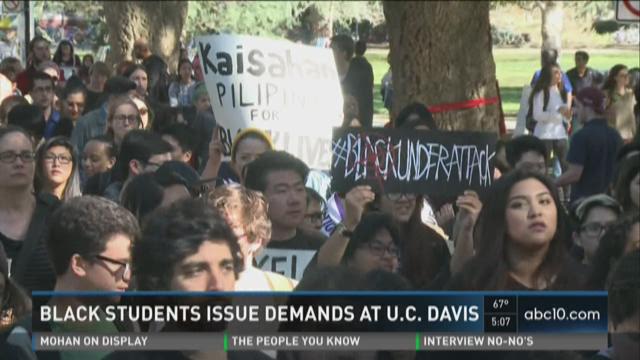 If the campus is going to be driven into a state of racial tension and alarm, and the university is going to spend public money meeting the demands of a student group, doesn’t everyone deserve to know what prompted all of it?
MORE NEWS: From Classroom to Consulate Chef: Culinary Student Lands Dream Job at U.S. Embassy in Paris
And if not, why not?
Here’s the little bit that officials are sharing with the public.
“Authorities on the UC Davis campus have launched a hate crime investigation after an African-American student reported being assaulted near her on-campus residence early Monday morning (Feb. 15), according to SanFrancisco.CBSlocal.com.
“According to a statement from the school, the student was walking near her residence in the West Village of campus around 3:00 a.m. when she was assaulted. The student called police and three people were arrested.
“Few details have been released about the incident, but UC Davis Police Chief Matt Carmichael said it was not a sexual assault. Police said the student did not require medical attention.
“According to police, 24-year-old Lonny Doyal Lee of West Sacramento is accused of a committing a hate crime, battery and public intoxication. Justin Sheppard, a 22-year-old from Sacramento, is accused of committing a hate crime, assault and public intoxication.
“A third suspect, 22-year-old Jake Lee of West Sacramento, is accused of public intoxication and is not accused of a hate crime. Police said the three suspects are not affiliated with the school.
MORE NEWS: Know These Before Moving From Cyprus To The UK
“All three suspects were booked at the Yolo County Jail.”
The university released a statement that said, “We hope this unacceptable incident will serve to further advance dialogue about how the UC Davis community can continue to build a culture and climate based on mutual respect, support and caring,” according to Fox40.com.
Wouldn’t it enhance the dialogue if the campus knew what the “unacceptable incident” was?
Authorities are describing the incident as an alleged assault, yet there was no sexual assault, and medical treatment was not necessary.
We keep hearing the term “hate crime.” What exactly does that mean?
Is it possible that ugly words were exchanged, feelings were hurt and that somehow qualified as a crime? If it were more than that, why aren’t authorities saying so?
If this incident was only verbal, do First Amendment questions come into play? While it is certainly despicable for anyone to use racial slurs in any conversation – assuming that was the case – is it wise, or constitutional, to charge someone with a crime for calling someone a hurtful name?
Have the California legislators who passed the “hate crime” law provided a specific list of words that are legal and illegal? When you’re talking about words that have the potential to hurt feelings, the list is infinite. Is it a hate crime any time anyone is offended by any word or phrase?
If there was name-calling involved, did it go both ways? If that was the case, should everyone involved be charged with a crime?
And if the incident was violent in nature, shouldn’t more details be released so other students can avoid becoming victims of a similar incident?
At first blush, this situation does not seem like so many other recent “incidents” on college campuses around the nation, where anti-racism student groups have been caught leaving racist messages in buildings or on parked vehicles, so they can have something to protest against.
If that happened, it’s unlikely that any arrests would have been made.
Perhaps university officials and police feel pressured to keep details of the alleged crime under wraps for the moment, due to the anger and tension on campus. But where in the world are the local reporters, and why aren’t they doing their jobs?
Why hasn’t a local newspaper or television news team used a freedom of information request to obtain a copy of the police report? Why hasn’t some aggressive reporter knocked on doors, rang phones off the hook and gathered enough information to give the public a general hint of what happened?
The lack of details has not stopped hundreds of student protesters from marching and making demands.
Mariah Watson, the president of a group using the acronym ASUCD (the news service report did not explain what the letters stand for), addressed the rally, according to DavisVanguard.org.
“The black community here in Davis DOES NOT FEEL safe. Anti-blackness pervades every aspect of this society including academia,” Watson reportedly said.
“Our reality is that we are in danger. For anyone questioning whether anti-blackness is real, a member of our community was attacked.”
Attacked how? What are the nature of her injuries? Does Watson even know what happened?
A photo cutline on DavisVanguard.org reported that two speakers at the rally, Kathleen Hinkson ad Kelechi Ohiri (who may or may not be students, no details were offered), described the hate incident.
“A black female student was the target of a hate crime in West Village,” one of them reportedly told the crowd.
Well, that clears things up.
Instead of doing some hard reporting to expose the details of the situation, local journalists have been pandering to the mass hysteria in an irresponsible manner.
DavisVanguard.org began a story published on Tuesday with the statement, “When a female African American student was attacked in a hate crime last week, many students believed it was an attack on all African American students.”
Has there already been a trial that determined that a hate crime was definitely committed and the accused are guilty? The words of the news report seem to indicate that.
Meanwhile, a campus group called “Black Under Attack” is demanding that the university install more emergency telephones on campus, improve outdoor lighting, and provide more evening public transportation options.
The group also demanded that the university “submit a letter of support urging the UC Regents to create a policy that targets anti-blackness in the UC,” DavisVanguard.org reported.
Would the three allegedly drunken men who allegedly committed this crime have been more likely to control themselves if there had been a university policy against anti-blackness?
University Chancellor Linda Katehi was at the rally, and did her best to soothe everyone’s anger and anxiety.
“It is unacceptable that we as UC Davis, saying that we are here to educate our students and being proud for this institution, it is unacceptable that we cannot make you feel safe,” Katehi said, according to Vanguard.com. “That we cannot make you feel like you have the opportunity to learn like everybody else.
“I want to apologize for that. It is unacceptable that we as a university have failed you. I cannot stand here and promise that tomorrow will undo all of these things. But I can promise to you that I will work as hard as I can to change things around here.”
What exactly needs to change? Shouldn’t that conversation begin with a full public disclosure of precisely what happened and why it was wrong? Without that, as far as the public can tell, this is much ado about nothing.


Join the Discussion
Comments are currently closed.