FRESNO, Calif. – There’s a high school rivalry brewing in California, but it’s not about school spirit.
It’s about water.
MORE NEWS: From Classroom to Consulate Chef: Culinary Student Lands Dream Job at U.S. Embassy in Paris
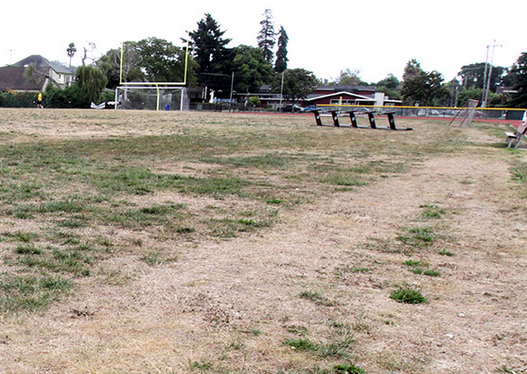
Bullard High School parent Steven Simonian is urging the Fresno Unified Board of Trustees to water the grass on the school’s football field more often after his son twisted his ankle on the dried out field this month, the Fresno Bee reports.
Simonian is frustrated because the athletic fields in the nearby Clovis Unified School District are greener and lusher than in Fresno. He took pictures of the different fields to show district trustees, and believes watering restrictions in Fresno are posing a safety hazard for the district’s students, and do not comply with head impact safety standards.
“I do not believe that a California law requiring schools to provide a safe environment can be overrode by a city requirement to limit watering, thereby creating a dangerous condition to children,” Simonion wrote to trustees last week, according to the Bee.
“Why must our kids suffer and these Clovis kids get to play on green fields with a maintenance staff ready to respond to problems within hours of being notified?”
Don Arax, Bullard’s football coach, seemed to agree with Simonion, but said the dried fields pose isn’t just an issue for football injuries.
“We’re in an era of concussions. We’re in a valley where the air quality is poor and a large percentage of kids have asthma and known allergies,” he said. “Common sense dictates that you have fields with green grass for those reasons alone.”
MORE NEWS: Know These Before Moving From Cyprus To The UK
Fresno Public Utilities Director Thomas Esqueda told the news site there’s several reasons why Clovis’ fields are lush and green, and Fresno’s are not.
Clovis uses well water that’s exempt from the city water rations, and Clovis officials filed for an exemption to the watering cutbacks ahead of Fresno schools, he said.
Essentially, Clovis school officials foresaw the safety risks dried athletic fields could pose to students and proactively mitigated the problem. Fresno did not.
“The exemption makes a distinction between functional and nonfunctional land and allows schools to water turf used for student recreation three times a week, instead of the standard two, Esqueda said,” according to the Bee.
Fresno school officials said they didn’t request help about their dried out athletic fields until last month.
“We’ve been following the city’s water regulations and it’s not been working, and clearly our fields are suffering because of it,” spokeswoman Amy Idsvoog told the Bee. “That’s why we reached out to the city in June addressing some of the safety and health concerns this parent raises.”
And while Fresno officials are struggling with their brown fields, Clovis officials are already working on new ways to conserve water.
Clovis spokeswoman Kelly Avants told the Bee the district is planning a long-term plan to recycle water for keeping their athletic fields healthy.
“School grounds need to be soft enough that no one is going to get injured as far as head impact safety goes. So we’ve worked with the cities to prevent that,” Avants told the Bee.
Many who read about the water issues online believe California schools would be smart to eliminate the need to water sports fields altogether.
“If this drought continues, I can see the California legislature providing state funds, perhaps matching, for districts to start installing artificial turf for football and other facilities,” Harr Kargenian posted to Facebook.
“It takes a tremendous amount of water, for instance, to keep a 100-yard football field in decent shape for a whole year. If this happened at many venues across the state, the water savings would be immense.”


Join the Discussion
Comments are currently closed.