INDIANAPOLIS – Citizens frequently complain about long campaign seasons, which these days typically start two years before general elections.
But sometimes those long campaigns are beneficial for voters, because they expose candidate weaknesses and thin out the field before the serious debate begins.
MORE NEWS: From Classroom to Consulate Chef: Culinary Student Lands Dream Job at U.S. Embassy in Paris
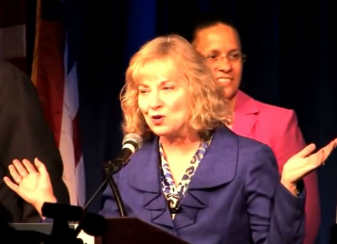
The failed gubernatorial candidacy of Glenda Ritz is a perfect example.
Ritz, Indiana’s state’s superintendent of K-12 instruction, announced Friday that she was ending her high profile run for governor, and will instead run for a second term as superintendent in 2016.
She had a great deal of momentum about two months ago when she announced she would be challenging her biggest political adversary, Republican Gov. Mike Pence.
She had a significant amount of public sympathy and support, particularly after Pence and the Republican majorities in the legislature attempted to pass a law earlier this year that would have probably resulted in Ritz’ removal as the chair of the state’s Board of Education.
Many voters perceived her as a victim of GOP bullying, particularly since she was the only Democrat elected to statewide office in Indiana.
But then she attempted to launch a campaign, and lots of problems quickly became obvious, according to an analysis published by the Indianapolis Star:
“Fundraising was a major hurdle for the Ritz campaign. She raised about $30,000 during the first half of the year – a fraction of the more than $1.6 million each raised by Democrat John Gregg and Republican Gov. Mike Pence.
“On top of her relatively meager fundraising, Ritz was facing an election complaint alleging that she raised more than $90,000 during the past two legislative budget cycles. State law bars fundraising activities during legislative sessions when a new state budget is written. Ritz dismissed the allegations as ‘clerical errors.’
“As recently as late July, Ritz told the Indianapolis Star that she was still committed to running for governor, saying her campaign was in the ‘organizational phase.’”
MORE NEWS: Know These Before Moving From Cyprus To The UK
Ritz’ organizational efforts were clearly not impressive. According to the newspaper, she and the other two Democratic candidates recently met with officials from the Indiana State Teachers Association, seeking an endorsement, but the union failed to give any of the three an early nod.
That could be interpreted as a slap in the face for Ritz, who is a former member of the teachers union’s executive board, and won election to her post as school superintendent with the full backing of ISTA in 2012.
The union gave the Ritz campaign roughly $180,000 that year, according to the Star.
Suddenly, with her biggest supporters holding back their support, Ritz apparently saw the writing on the wall.
“Now is not the right time for me to run for governor,” Ritz was quoted as saying last Friday.
Suddenly she was refocused on her elected responsibility – overseeing K-12 education in Indiana. That stopped being her top priority for two months, but she apparently found her passion again.
“Under my leadership, I have brought the discussion of public education into the public discourse and have started to fundamentally change how we support schools,” Ritz was quoted as saying by the Star. “My work is not finished, and my passion is stronger than ever. I am resolutely dedicated to educators, students, and families from Pre-K to graduation.”
It will be interesting to see if any strong Republicans try to take advantage of Ritz’ sudden vulnerability and challenge her for superintendent in 2016.


Join the Discussion
Comments are currently closed.